Animation Handbook
The Animation Handbook is your guide to using motion with purpose in digital product design—transforming static interfaces into dynamic, meaningful experiences. Written by animation expert and two time Apple Design Award winner Ryan McLeod, the book draws on insights from brands like Google, Slack, Dropbox, and Apple to show how animation can communicate hierarchy, reinforce brand personality, and guide user behavior. You’ll explore the principles of timing, easing, and choreography, and learn how to balance delight with usability so that every movement serves a clear function.
Through real-world examples and practical techniques, you’ll discover how animation can smooth transitions, reduce cognitive load, and bring emotional resonance to your products. Whether you’re designing onboarding flows for a startup or refining micro-interactions for a global platform, you’ll find the guidance you need to create experiences that feel alive, responsive, and human.
Upgrade to unlockAlready a member
Available in PDF and epub formats.
All nine books are included with membership, $72 a year.
A look inside
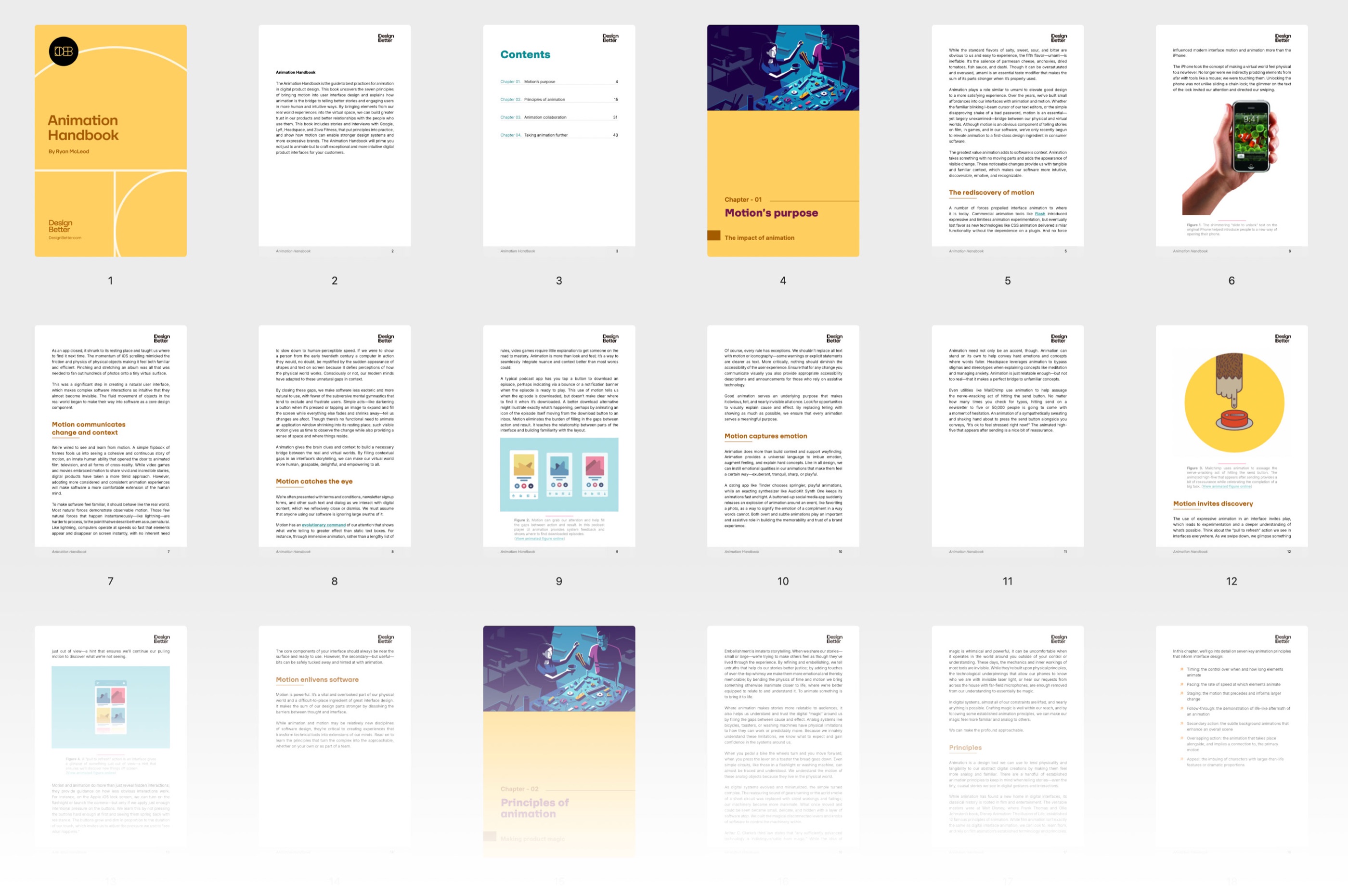
What’s inside
Motion’s purpose
Why motion matters: it provides context, guides attention, conveys emotion, and invites discovery—bridging the gap between physical and digital with examples like iPhone interactions, Headspace explainers, and Mailchimp’s reassuring send states.
Principles of animation
Seven principles—timing, pacing, staging, follow-through, secondary action, overlapping action, and appeal—adapt classic animation craft to interfaces, using easing, directionality, and subtle flourishes to make state changes legible and human.
Animation collaboration
How teams put motion to work: Zova Fitness prototypes early with engineering; Headspace aligns behavior, easing, duration, and sequencing from wireframes; Google’s Material defines informative/focused/expressive motion; Lyft’s system is intentional, responsive, expressive—and accessible.
Taking animation further
Nuance, consistency, humanity, and fluidity: keep motion purposeful (e.g., restrained map pins), maintain coherent physics (Tinder cards, iOS Control Center), add empathetic cues (typing dots), and design fluid, prototype-driven gestures that feel like extensions of the mind.
About the author
Upgrade to access the entire library
Your membership also gets you access to our private Slack of designers, access to bi-weekly Design Club critiques and career discussions, four podcast episodes per month, and our newsletters that go deep into design and the creative process.